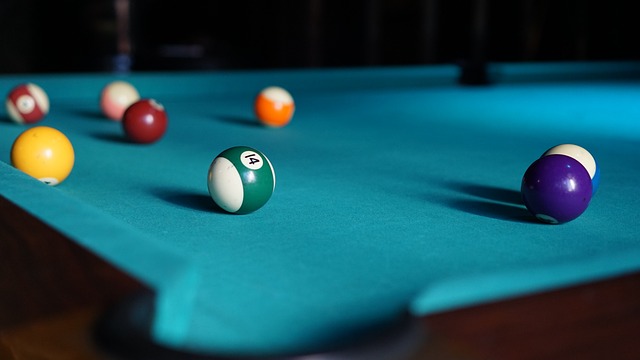
When two billiard balls collide, physics comes into play. This article explores the two-dimensional dynamics of such collisions, highlighting the principles that govern their movement and interaction. Understanding these concepts can enhance your game strategy and appreciation for the sport. Join us in this fascinating journey!
Understanding the Physics: Analyzing Two-Dimensional Collisions of Billiard Balls in Pool and Snooker
Understanding the physics of billiards is crucial for improving gameplay in pool and snooker. In these games, the collision of balls follows the principles of two-dimensional physics. When a cue ball strikes another ball, the angle of incidence equals the angle of reflection. This means that the angle at which the cue ball hits another ball will significantly influence the direction that the target ball takes after the collision.
In terms of momentum, the conservation of momentum plays a vital role. Before the collision, the total momentum can be calculated as the product of mass and velocity of the cue ball. After the collision, this momentum is transferred to the other ball, affecting its speed and direction.
Additionally, the coefficient of restitution quantifies how elastic the collision is. A perfectly elastic collision results in no kinetic energy loss, while inelastic collisions dissipate energy, often through sound and heat.
For players, understanding these concepts can enhance their shot strategies. By predicting how balls interact post-collision, players can plan subsequent shots, increasing their chances of winning.
In snooker, the game’s unique rules necessitate even greater precision. The positioning of balls on the table adds complexity to the physics involved. Players must calculate angles and distances carefully to execute strategic shots.
In summary, mastering the physics behind two-dimensional collisions in billiards allows players to make informed decisions, leading to better performance in both pool and snooker.
Understanding the Physics of Ball Collision
The collision of two billiard balls is a fascinating study in physics, governed primarily by the principles of momentum and energy conservation. When two balls collide, they transfer energy and momentum between each other, which can be described using vector analysis. The angle at which they hit each other plays a crucial role; this angle, known as the angle of incidence, determines how the balls will move post-collision. Additionally, the coefficient of restitution, which measures the elasticity of the collision, impacts whether the collision is perfectly elastic or inelastic. In pool and billiards, most collisions can be assumed to be nearly elastic, meaning that kinetic energy is conserved.
The Role of Spin in Collision Dynamics
Spin significantly affects the outcome of a collision in pool, billiards, and snooker. Hooking or applying sidespin to a ball before it strikes another can alter the collision dynamics drastically. For example, when a ball with topspin collides with another stationary ball, it can impart additional motion to the second ball and affect its direction. This phenomenon is often utilized by players to achieve strategic positions on the table. Players must understand how different spins interact during a collision to enhance their gameplay and execute precise shots.
Practical Applications in Game Strategy
Understanding the mechanics of ball collisions not only enriches a player’s knowledge but is also essential for developing effective strategies during a game. By mastering the angles and spins involved in ball collisions, players can position themselves advantageously for subsequent shots. Strategic planning in billiards involves calculating the optimal angles for both the first shot and potential follow-up shots, maximizing opportunities to pocket balls. This knowledge transforms a player’s approach from simple execution of shots to a comprehensive tactic that considers future moves, ultimately leading to improved performance on the table.
FAQ
What principles govern the collision dynamics of two billiard balls in a two-dimensional space?
The collision dynamics of two billiard balls in a two-dimensional space are governed by several key principles. When two balls collide, they typically undergo an elastic collision, meaning that both momentum and kinetic energy are conserved. The laws of reflection dictate that the angle of incidence equals the angle of reflection, impacting their trajectories post-collision. Additionally, the point of impact determines how the velocity vectors change, affecting the direction and speed of each ball after the collision.
How does the angle of incidence affect the outcome of a collision between two billiard balls?
The angle of incidence significantly affects the outcome of a collision between two billiard balls. When a ball strikes another, if the angle of incidence is greater, the resulting angle of reflection will also be greater, leading to different trajectories. This relationship is crucial in games like pool, billiards, and snooker as it influences positioning and strategy for subsequent shots.
What factors influence the energy transfer during a two-dimensional collision between billiard balls?
In a two-dimensional collision between billiard balls, several factors influence the energy transfer:
1. Angle of incidence: The angle at which the cue ball strikes the target ball significantly affects how energy is distributed.
2. Ball mass: The mass of both balls determines how much momentum can be transferred during the collision.
3. Velocity: The speed of the cue ball before impact directly impacts the kinetic energy transferred to the target ball.
4. Friction: The contact surface and any friction present can affect how much energy is lost in the form of heat or spin.
5. Elasticity: The degree to which the balls are elastic (how they deform during the collision) influences energy loss and rebound angles.
Understanding these factors helps players improve their strategies in pool, billiards, and snooker.
In conclusion, understanding the dynamics of two billiard balls colliding in two dimensions provides valuable insights into the complexities of pool, billiards, and snooker. By analyzing factors such as angle, speed, and spin, players can enhance their strategic approach to the game. This knowledge not only improves individual performance but also adds a layer of enjoyment and appreciation for the physics that govern these classic cue sports. As players continue to explore the intricacies of ball collisions, they will find that mastering these concepts is essential for achieving greater success on the table.