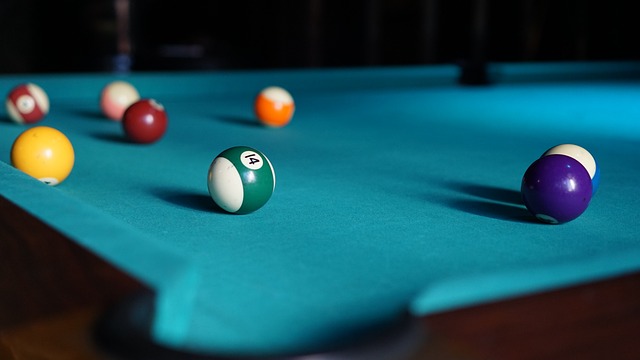
Understanding the physics behind elastic collisions is crucial for mastering the game of pool. This article delves into how momentum and energy transfer influence ball behavior, enhancing your skills and strategy on the table. Unlock the secrets of these interactions for a competitive edge!
Understanding Elastic Collisions: The Physics Behind Pool Balls in Action
Elastic collisions are a fundamental concept in the physics of pool, billiards, and snooker. When two pool balls collide, they do so in a manner that conserves both momentum and kinetic energy. This characteristic defines an elastic collision.
In an elastic collision, the total momentum before and after the collision remains constant. This can be represented by the equation:
m1 * v1 + m2 * v2 = m1 * v1′ + m2 * v2′
where m represents mass, v is velocity, and the primes indicate post-collision values.
Another critical aspect to consider is kinetic energy conservation. The sum of the kinetic energies of the two balls before the collision equals the sum after the collision:
(1/2 * m1 * v1^2 + 1/2 * m2 * v2^2) = (1/2 * m1 * v1’^2 + 1/2 * m2 * v2’^2).
When a player strikes the cue ball, the force of the cue stick creates momentum that is transferred to the cue ball. Upon hitting another ball, this momentum is transferred once again. In a perfect elastic collision, players will see the balls continue on predictable paths after contact, often at angles defined by the impact point on the balls.
The angle of incidence and the angle of reflection come into play during these interactions. According to the laws of reflection, the angle at which the cue ball strikes another ball will equal the angle at which it departs, which allows players to strategize their shots effectively.
Understanding the principles of elastic collisions not only enhances gameplay but also improves players’ ability to anticipate the outcome of their shots. This knowledge enables players to become more skilled in executing complex plays, such as two- or three-ball combinations. Thus, mastering the physics behind these elastic collisions is essential for anyone serious about the game.
“`html
Understanding Elastic Collisions in Pool
In the context of pool, billiards, and snooker, elastic collisions refer to interactions between balls where both momentum and kinetic energy are conserved. This means that after the collision, the total energy and momentum of the system remain the same as they were before the impact. The concepts of elasticity and collision dynamics are crucial for players to understand how their shots will affect the movement of other balls on the table. Knowing how to predict these outcomes can significantly enhance a player’s strategy and execution during a game.
The Physics Behind Ball Interactions
When two pool balls collide elastically, they behave according to the principles of classical mechanics. Each ball transfers energy to the other upon collision; the angle of incidence and the angle of reflection play significant roles in determining the trajectory of both balls post-collision. Furthermore, the masses of the balls (which are typically uniform) and their velocities at the moment of contact can be used to calculate the resulting speeds and angles using formulas derived from conservation laws. Recognizing these physical properties allows players to make predictive shots and assess how multiple balls interact with each other during gameplay.
Implications for Strategy and Gameplay
Understanding elastic collisions not only enhances technical skill but also influences strategic decision-making in pool games. Players who master the art of predicting and controlling post-collision trajectories can create advantageous situations for themselves while potentially setting traps for their opponents. Effective use of spin and angling can drastically alter the dynamics of the game, allowing skilled players to manipulate the positions of balls on the table. By incorporating knowledge of elastic collisions into their gameplay, players can develop a more sophisticated approach, improving their overall performance in competitive settings.
“`
FAQ
What is the significance of elastic collisions in pool, billiard, and snooker games?
In pool, billiard, and snooker games, elastic collisions are significant because they ensure that both momentum and kinetic energy are conserved during the interactions between balls. This means that players can predict how balls will react after striking one another, leading to better strategies and shot execution. Understanding these principles allows players to effectively control the game dynamics and enhance their overall performance.
How do elastic collisions affect the trajectory of the balls in a game?
In pool, billiard, and snooker, elastic collisions significantly impact the trajectory of the balls. When two balls collide, they bounce off each other while conserving both momentum and kinetic energy. This preserves their speed and direction, resulting in predictable paths that are crucial for strategizing shots. Understanding these dynamics allows players to calculate angles and force, enhancing their overall gameplay.
Can the principles of elastic collisions be applied to improve a player’s skill in these cue sports?
Yes, the principles of elastic collisions can significantly improve a player’s skill in pool, billiards, and snooker. Understanding how balls collide and transfer momentum helps players predict outcomes and enhance their shot accuracy. By mastering these principles, players can make better strategic decisions on positioning and angle adjustments, leading to improved overall performance.
In conclusion, understanding the concept of elastic collisions in the context of pool, billiards, and snooker is critical for both players and enthusiasts alike. These interactions between balls not only highlight the fundamental physics involved in the game but also enhance a player’s strategic approach during matches. By recognizing how momentum and energy conservation play crucial roles in determining the outcome of each shot, players can make more informed decisions on the table. Furthermore, the insights gained from studying these collisions can lead to improved techniques and a deeper appreciation for the complexities of the game. Ultimately, mastering the art of predicting and manipulating ball trajectories through effective use of elastic collisions can significantly elevate one’s performance and enjoyment of pool, billiards, and snooker.